Introduction
For robotic automation, CNC machine metal parts have problems such as precision instability and cost overruns, often caused by improper material selection. Traditional methods, such as simply considering strength and price, ignore important elements such as system synergy and heat control. This article presents a framework for the scientific selection of materials and quality control in the entire process.
How Does CNC Machining Metal Affect the Positioning Accuracy and Repeatability of Robotic Systems?
The ultimate performance of the robotic system is dependent upon the positioning accuracy and repeatability of the end-effector. The material properties of the CNC milling components act as the primary determinants of the performance.
The Primacy of Material Rigidity
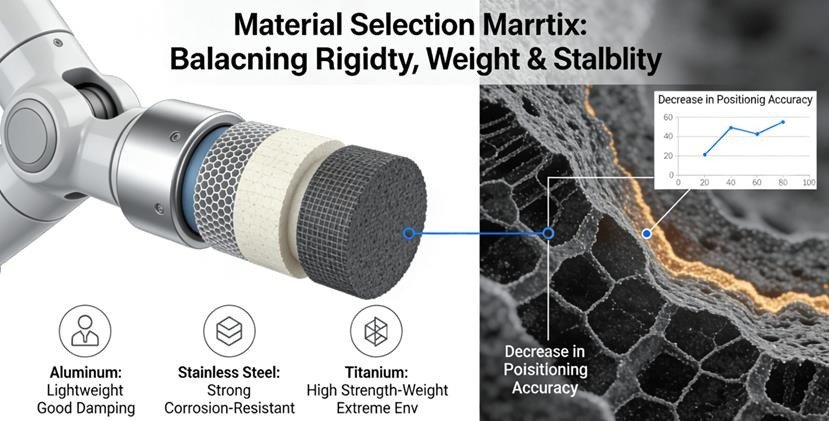
The rigidity of the material, or the modulus of elasticity, is the primary determinant of the amount of deformation that occurs in the material under load. For high-speed or high-payload robotic operations, materials with low rigidity, such as certain soft aluminum alloys, experience more elastic deformation, causing the end-effector position to diverge from the programmed theoretical path, thereby affecting the overall accuracy of the motion. High-rigidity materials such as 7075 aluminum or steel are a prerequisite.
The Stealthy Impact of Thermal Effects
Thermal deformation is the “silent killer” in precision mechanics, particularly in CNC milling metals. It is mainly due to two effects:
l Residual Stress due to Machining Heat :
Incorrect machining procedures in CNC milling can cause residual stress, which can be released over time and in response to temperature changes, leading to changes in dimensions.
l Ambient Temperature Fluctuations:
The value of the coefficient of expansion of the material used is a significant factor. There are materials, for example, aluminum alloys, whose expansion coefficient is very high. This implies that, as a response to changes in ambient temperature, these materials may change their dimensions significantly. On the other hand, there are materials, for example, Invar, whose expansion coefficient is very low.
Damping Characteristics and Dynamic Performance
The internal damping characteristics of a material are also important in terms of how well a system will be able to dampen its own vibrations. For example, in terms of high-speed starts, stops, and changes in path, aluminum alloys tend to have a better damping response than stainless steel, allowing any residual vibrations to die away more quickly. This is particularly relevant to the high demands for component accuracy and reliability specified in standards such as ISO 10218-1:2025 for safety in industrial robot systems (e.g., to Performance Level d / SIL 2). Hence, scientific material selection is a key enabler in terms of achieving high safety and high performance from advanced manufacturing technology.
Why is Titanium Alloy CNC Machining Cost a Worthwhile Investment in Aerospace Robotics?
Robots operating in the aerospace sector have to endure quite a few harsh scenarios including extremely high temperatures, strong vibrations, and working with materials that can be corrosive. Since the initial titanium CNC machining cost is significantly higher than that for options like CNC machining aluminum parts or a standard stainless steel CNC machining service, using titanium actually offers so much more value that it easily overshadows the initial cost.
The reason that titanium displays such extraordinary properties is that no other metal has such a good strength-to-weight ratio and, in addition, titanium is very resistant to corrosion. Compared to aluminum and stainless steel, titanium components can withstand greater stresses and more severe temperature fluctuations, and they contribute to a reduction in the overall weight. Weight is an extremely important factor for aerospace companies aiming to get the perfect thrust-to-weight ratio. On the standards side of things, the International Organization for Standardization and others have set very stringent material standards for the aerospace industry.
The stability and durability of titanium make it the material of choice for ensuring that high standards are met. A total cost of ownership analysis shows that the benefits of using titanium in components are undeniable. Although there is an extra cost of 40-60% in the initial machining process, the benefits include the ability of the components to reduce downtime due to part failure by as much as 30%. Additionally, the maintenance intervals can be extended multiple times. For automated production lines or multibillion-dollar aircraft manufacturing plants operating around the clock, the cost of the material is justified by the savings in not experiencing an unplanned stoppage of operations. Therefore, an investment in titanium CNC machining is an investment in reliability, longevity, and overall cost savings.
How to Choose the Most Economical CNC Machining Metal for Collaborative Robots (Cobots)?
Collaborative Robots (Cobots), which are intended for sharing the working environment with humans, require particular attention in CNC machining including safety aspects, light-weight construction and a surface finish that is easy and safe for the user. Finding the most economical material involves making the right trade-off between these various requirements.
See also: Reliable House Movers in Sydney for Stress-Free Local Relocations
Safety as the Paramount Principle
Cobots, as per the ISO/TS 15066 standard (requirements incorporated in the ISO 10218-2:2025 standard), need to adhere to force and power limits. This is particularly applicable in the selection of materials for parts such as the housing, tools, and parts that may come into contact with humans. The material should enable the implementation of designs with non-sharp edges and non-hard surfaces. Good machinability is beneficial in the provision of high-standard chamfering and polishing services through CNC milling services near me.
The Core Trade-off: Aluminum vs. Stainless Steel
The most crucial consideration in robotics automation is the selection of materials in CNC machining, i.e., whether it is aluminum vs stainless steel CNC machining.
l Aluminum Alloys:
The advantages lie in their light weight, machinability, and cost. High-specific-strength alloys, such as 6061-T6, are very good at reducing the inertia of the manipulator, which is important for energy efficiency and speed. They should be the preferred choice for the majority of the cobot arm structure.
l Stainless Steel:
The advantages lie in their high strength, wear resistance, and corrosion resistance. They should be used for joint, connector, or component parts that may be frequently cleaned, such as in the food or medical industry. They have a high difficulty level in machining and weight.
The Economic Evaluation of Suppliers
Working with a local supplier may be advantageous from the point of view of easier communication and faster iteration of prototypes. However, a globalized supplier might have more advantageous cost structures or quality control mechanisms. In any case, the phase of the project that the supplier is to be used for, the amount of the order, and the specific certification that may be required should be taken into consideration to establish a cost assessment framework. A good starting point might be to use CNC milling aluminum.
How Do China CNC Metal Machining Suppliers Meet International Robotics Manufacturing Standards?
With the in-depth integration of the global robotics industry chain, the leading suppliers of china CNC metal machining supplier have evolved systematically to meet and even surpass the international standards of the manufacturing industry.
The international standards of ISO 9001 (Quality Management System), IATF 16949 (Automotive Quality System), and AS9100D (Aerospace Quality System) specify certain requirements in detail for the process of CNC machining. For example, taking the supplier of the company that is certified with ISO 14001 (Environmental Management System), ISO 9001, IATF 16949, and AS9100D as an instance, the process of complying with the standards is shown in the following ways:
The procurement of raw materials is traceable and meets the standards of American Society of Testing Materials( ASTM). The parameters of the process of machining are optimized with the help of Statistical Process Control (SPC). The process of inspection is carried out with the help of Coordinate Measuring Machines (CMM) and optical profilometers.
In order to bridge the geographical gap, the leading suppliers make heavy use of digital collaborative technologies, which are the hallmark of advanced manufacturing technology. With cloud-based technologies for collaborative 3D part sharing, real-time DFM analysis, and online tracking of manufacturing progress and inspection reports, global clients experience the same kind of response and engineering support as if they were working with a local partner. Every aspect, from design to finished part, is carefully designed to meet the very stringent criteria of global robotics projects.
From Prototype to Mass Production: Supply Chain Optimization Strategies for CNC Machined Metal Components
The twin challenges of scaling robot parts, from prototype validation to production, relate to the materials and the supply chain. However, the key to the optimization process lies in standardization and the control of the process, as well as the supply chain. Thus, the key to the process of maintaining the quality of the materials used lies in the process of standardization. This would ensure that there would be no changes in the performance of the materials. Similarly, the process of optimizing and then locking down the parameters of the machine would ensure the quality of the process. Statistical Process Control would ensure the quality of CNC milling components.
In an environment where the International Federation of Robotics highlights the importance of the supply chain, flexibility in strategies is required. In robotics automation, for example, the hybrid approach is ideal, where local CNC milling services near me are relied upon for prototype development due to their responsiveness, and global precision manufacturers are relied upon for mass production due to their economies of scale. When considering potential suppliers, their engineering support should be taken into account, such as their ability to provide DFM for free. This could help prevent problems in the design stage, thus saving time and costs in the long run.
Conclusion
The achievement of robotic automation largely relies on the scientific selection and precise manufacturing of CNC machined metal parts. From the mechanical properties of materials to process optimization, as well as cost management and compliance with international standards, every step in the process directly impacts the reliability, accuracy, and ROI of the robotic automation system. Through a scientific material selection process, the reliability of robotic components can be greatly improved.
Author Biography
The author of this article is an expert in the field of manufacturing engineering, with 15 years of experience in the field of precision manufacturing, materials science, and process optimization for robotic automation components. The author has worked in collaboration with internationally certified suppliers such as JS Precision to successfully execute hundreds of high-precision robotic component projects.
FAQs
Q1: What are the primary differences between CNC machined metals and 3D printed metals for application in robotic systems?
A1: CNC machined metals have the ability to be machined to a higher level of dimensional accuracy, typically around 0.005 mm, they also generally have better surface finish and higher material density. On the other hand, 3D printed metals are primarily used for creating prototypes of complicated shapes and producing tailor-made parts for small batch production.
Q2: What factors should one consider while evaluating a CNC machining supplier for manufacturing robotic system components?
A2: One should look for the supplier having international certifications (such as ISO 9001, IATF 16949), equipment for precision inspection (e.g. coordinate measurement machine, profilometers), capability of SPC process control, and surgical experience in the robotics industry. Meeting their engineers is also a great way to evaluate helping support and understanding of their willingness and competence to respond to your needs.
Q3: How to decide between stainless steel and aluminum for the manufacture of a collaborative robot?
A3: Stainless steel normally offers better resistance to corrosion and higher strength whereas aluminum is significantly lighter, easier to machine, and offers a more economical option when the robot operates at high speeds.
Q4: What are the major factors that contribute to the high cost of titanium alloy machining?
A4: The main issue with titanium is that it is a very hard metal and also has poor thermal conductivity. Therefore, tools used on titanium wear out very quickly. The machining process needs the use of special coolants and low cutting parameters. Despite all that, titanium’s strength-to-weight ratio is the best and it is also biocompatible. So, it remains the top choice for aerospace and medical robotics industries.
Q5: What are the benefits of using local CNC machining services over ordering from international suppliers?
A5: Local CNC machines can respond to customers quickly and have good communication. They are best for small batch or prototype production. International CNC machine suppliers have deeper pockets for buying machines, have better quality control and benefits of large scale production.